


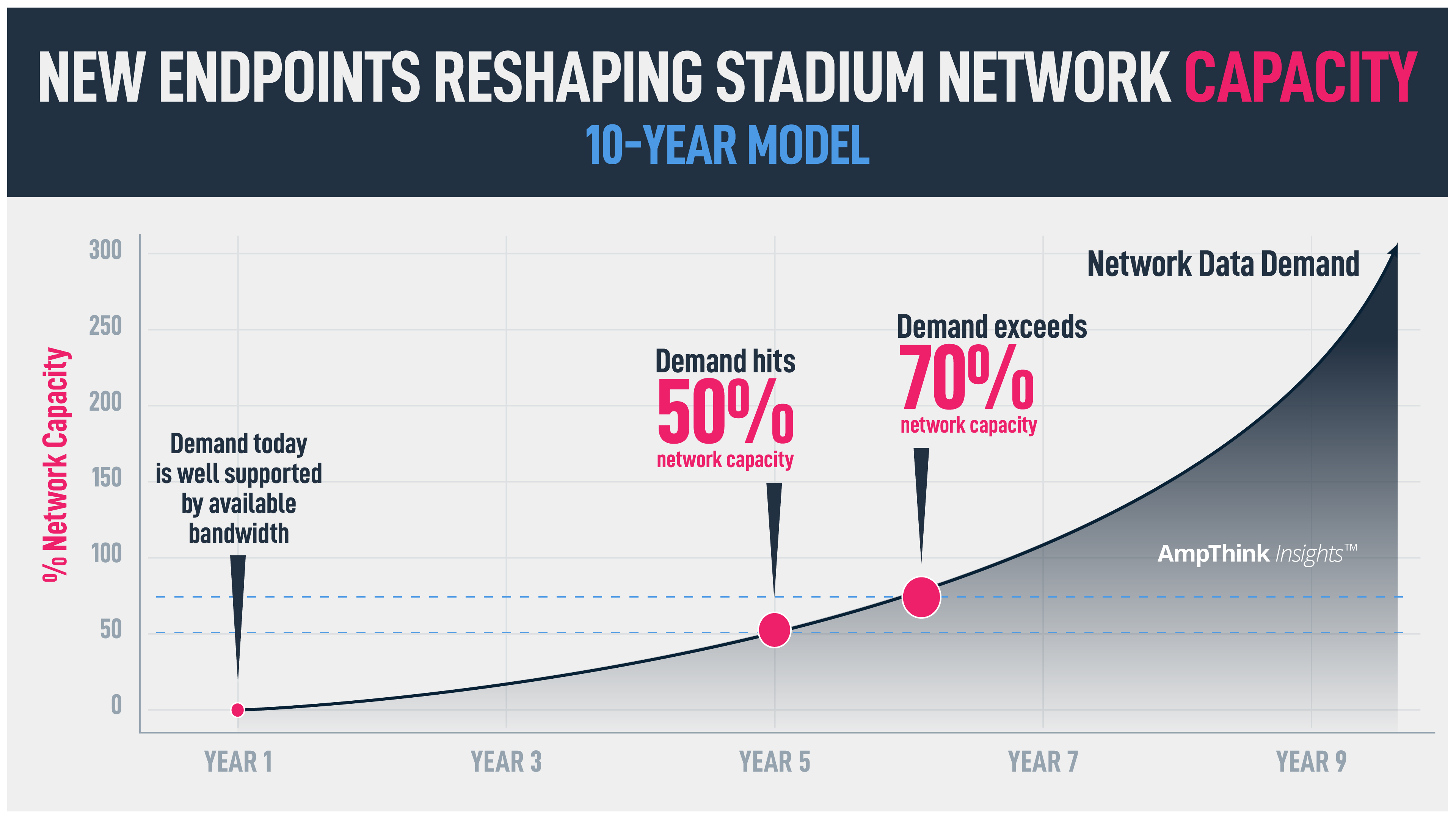
The promise of AI-enabled stadium operations depends on network capacity. As venues layer automation into their environments, the underlying math suggests capacity may be consumed faster than traditional planning assumptions anticipated.
That possibility is grounded in broader technology trends. The number of connected IoT devices is projected to grow from roughly 21 billion in 2025 to more than 50 billion by 2035, driven in part by AI integration. In large venues, this translates into expanding layers of cameras, sensors, control systems, analytics platforms, and automation tools operating continuously rather than intermittently.
Using these growth predictions, this graph models how network demand can grow over time as more connected systems are added inside a stadium. The X axis represents time, and the Y axis shows how much of the available network capacity is being used. The rising curve reflects two forces happening at the same time: more devices connected to the network and more data produced by each device. The horizontal dotted lines mark ranges where networks become harder to operate reliably.
At first, additional systems feel manageable because there is still unused capacity. Over time, however, as more endpoints are added, always-on operational systems begin to consume the margin that was originally intended to handle peak event traffic. The available cushion shrinks gradually, leaving less flexibility each year.
Near-term endpoint growth will likely come from operational systems already being deployed today, including automation platforms, analytics tools, and connected building infrastructure. A second wave could follow later in the decade as ambient sensing technologies mature and enable far larger numbers of low-cost sensors to be deployed throughout venues and adjacent districts. Because this next phase layers on top of existing systems rather than replacing them, it has the potential to accelerate endpoint growth and network demand beyond current planning assumptions.
The purpose of this model is not to predict exactly when any stadium will reach its limits. It is meant to show how small additions compound over time and why capacity pressure often appears sooner than expected.
For venue owners pursuing the operational automation promised by AI and IoT, the implication is straightforward. Network capacity planning shifts from a periodic capital decision to a continuous infrastructure strategy, as compounding demand can shorten the useful life of installed systems. The real risk is not running out of capacity. It is discovering too late how little runway remains

Garland, TX 75042


