


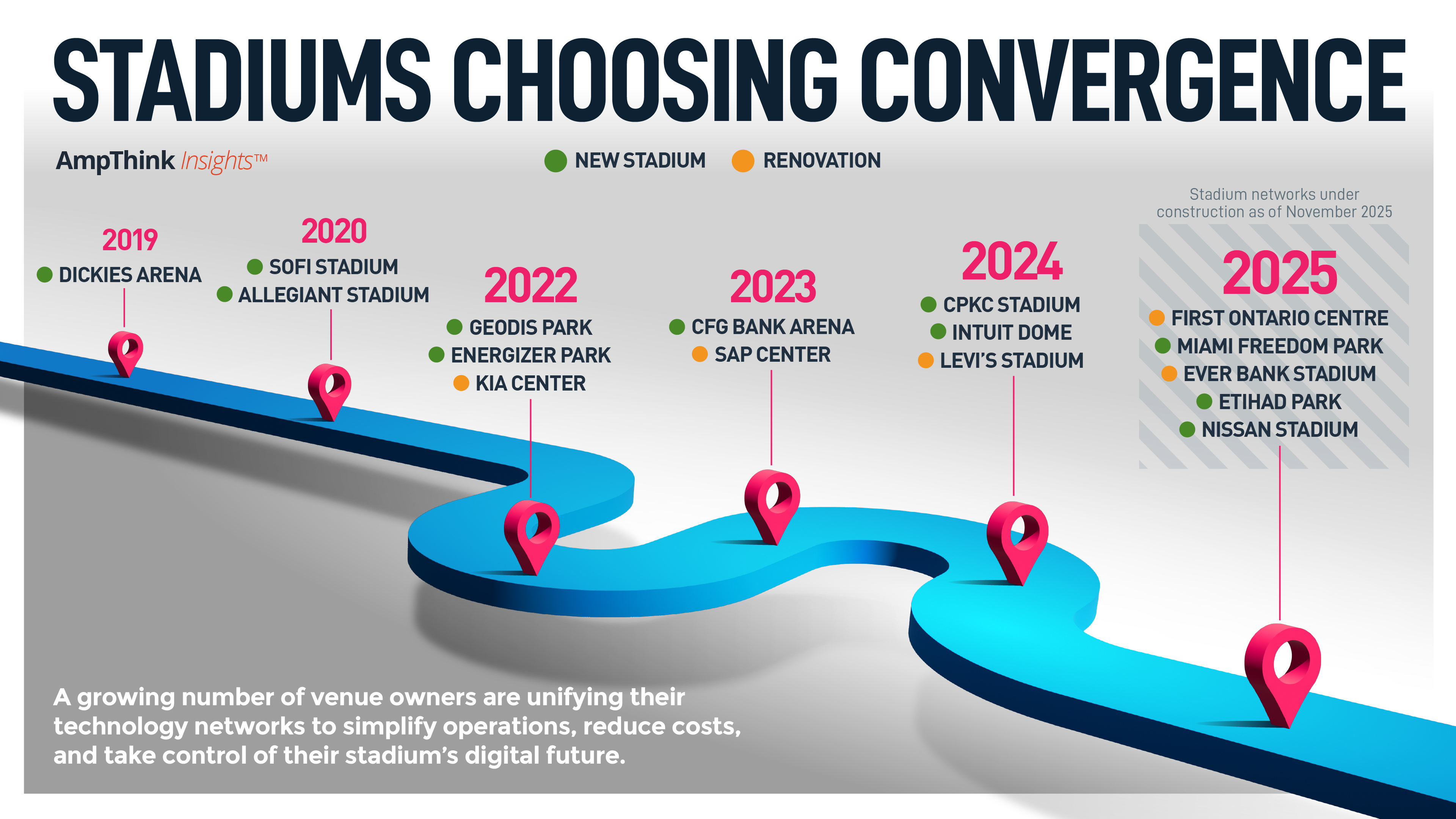
It’s official. Convergence is the new paradigm in stadium tech.
Before electricity, stadiums could only host day games.
When power arrived in the 1930s, lights changed everything. The business of sports expanded into the night, doubling revenue potential and transforming the fan experience.
In the 1970s, computer networks began linking local systems together, allowing data to flow to cash registers, ticketing, and operations teams. Stadiums entered the networked era.
By the 1990s, the internet and cellular connectivity ushered in the connected era. Persistent, wireless data changed commerce, operations, and fan engagement, enabling everything from digital signage to mobile ticketing and streaming.
Then in 2019, something new happened. The first hyperconverged stadium network went live. It unified a wide array of building systems onto a single, software-defined backbone.
That milestone marked the beginning of a new paradigm now spreading across the industry: the era of convergence.
Convergence does more than simplify infrastructure. It lays the foundation for what is now being called the smart stadium — a venue where every system is interconnected, data-driven, and adaptive. Converged stadium tech can scale faster, operate more efficiently, and continually reinvent the fan experience.
Just as media paradigms like print, radio, and television emerged, overlapped, and persisted, so do stadium technology paradigms. Earlier eras do not disappear — they accumulate. Each layer adds functionality but also complexity and cost. Optimizing across those layers requires specialized expertise.
At AmpThink, that is what we do. We help owners and operators design, build, and optimize across every layer of stadium technology so every investment delivers maximum performance, efficiency, and long-term value.

Garland, TX 75042


